Energy & Infrastructure
LatestConocoPhillips: From Reset to the Next Test · Part I of III
The Second Founding of ConocoPhillips: When the First Model Broke
Essay · · 7 min read · By Bryan J. Kaus
Research note. This essay is drawn from a broader Kaus Capital / Australis study of ConocoPhillips' operating, financial and leadership record from 2012-2026, based primarily on public filings, company disclosures and earnings-call transcripts. It is not an insider account.
When ConocoPhillips split itself in two in 2012, I went with Phillips 66.
That put me in an odd position as the years passed. I knew the institutional roots, some of the people and much of the history from which both companies came. I understood the separation from close enough to know that neither side was starting from scratch. But I was not inside the company Ryan Lance went on to build.
There is a temptation, when you know the lineage of an institution, to fill in conversations you never heard. I do not want to do that here. What I can do is look at the record: what management said, where the capital went, what the assets did, how the company behaved when conditions changed, and what was different afterward.
Fourteen years later, with Lance preparing to hand the chief executive role to Andy O'Brien, I went back through that record because I wanted to understand what had actually happened.
The easy version is that ConocoPhillips became larger, more efficient and more valuable under a long-serving CEO.
That is true, as far as it goes.
It is also not the most interesting part of the story.
The ConocoPhillips Ryan Lance leaves behind is not really the company he set out to build in 2012. The first version failed an important test.
That is where I think the leadership story begins.
The company they thought they were building
The ConocoPhillips that emerged from the separation was not a turnaround.
It was a capable, technically deep global institution with a large resource base, major projects under development, experienced people and substantial access to capital. Lance was not an outsider brought in to dismantle it. He was 50 years old, a petroleum engineer, and a long-time institutional veteran with operating, technical, project and geographic experience across ConocoPhillips and its predecessor companies.
That matters because the original strategy made sense in the context of the company and the leader who inherited it.
The newly independent ConocoPhillips talked about safety and execution, a sector-leading dividend, roughly 3 to 5 percent annual production growth, 3 to 5 percent annual margin improvement and better returns.
Each objective was reasonable by itself.
Together, they created a demanding contract.
The company still carried a large long-cycle project queue. Its existing production base naturally declined. Growth required capital. The dividend created a substantial fixed claim on cash. And the refining, chemicals and midstream businesses that had once provided some diversification from upstream commodity prices now belonged to Phillips 66.
These were not foolish people making obviously foolish decisions. That is what makes the lesson useful.
A great deal of bad leadership analysis starts after the outcome is known. The spreadsheet is opened in 2026, the answer is visible, and everyone who acted in 2012 is judged for failing to know it in advance.
That is not a serious standard.
The right question is whether the strategy was coherent using the information available at the time - and whether management adapted quickly enough when the evidence began moving against it.
I have become increasingly skeptical of corporate strategies that insist several competing objectives are all first priority.
Growth can be rational. A strong dividend can be rational. A large project program can be rational. Balance-sheet resilience is certainly rational.
But in a cyclical business they cannot all be treated as fixed when the cash available to fund them is anything but fixed.
Eventually the arithmetic gets a vote.
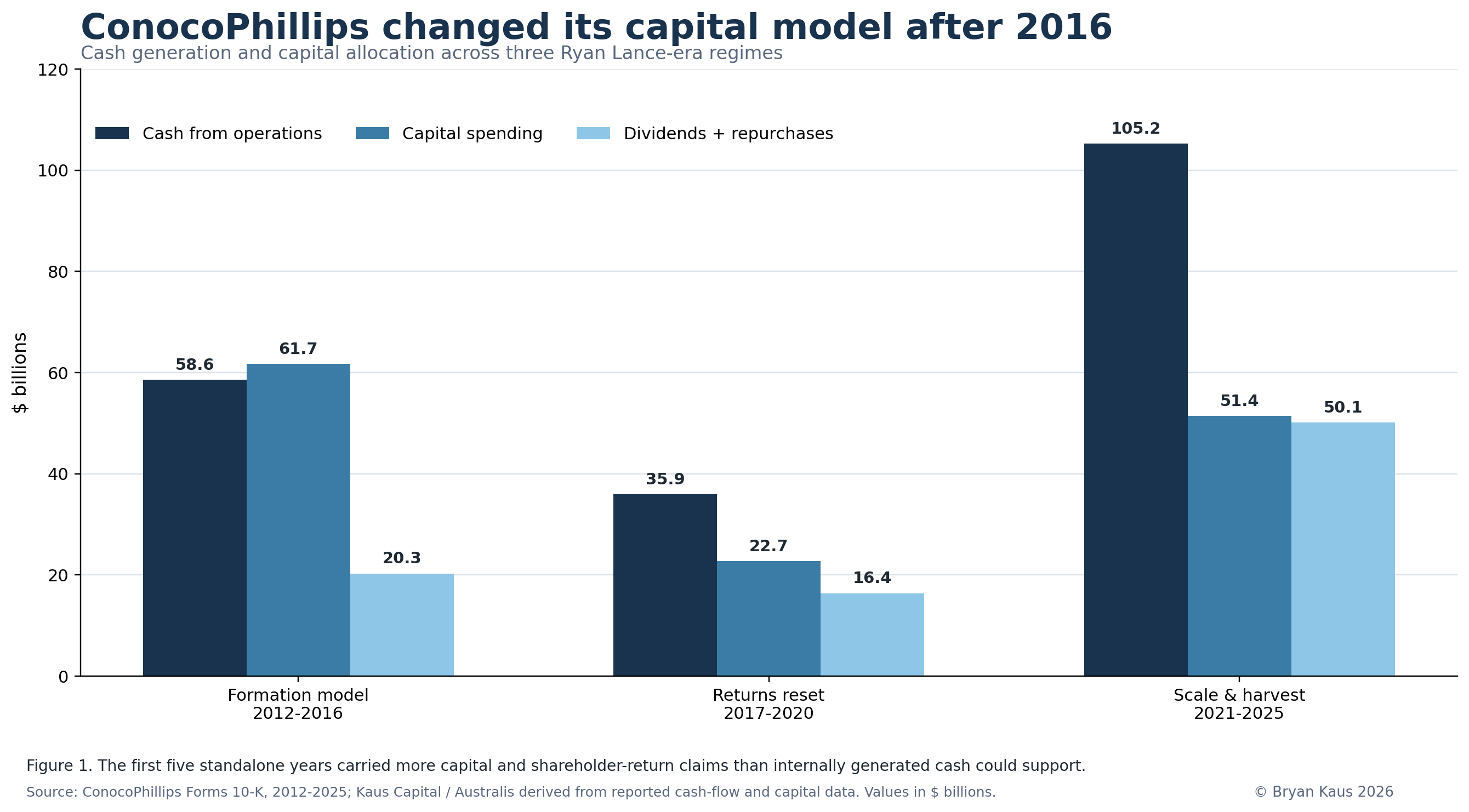
The tension was visible early. In 2012, ConocoPhillips generated approximately $13.9 billion of operating cash while spending about $14.2 billion on capital. It also returned roughly $8.4 billion through dividends and repurchases.
That did not mean the strategy was obviously wrong. Oil prices were strong. Major projects were progressing. The company had enormous resources and financing capacity.
But the model contained an assumption that was never really written as an assumption:
The environment could disappoint, but not too much for too long.
A strategy can be coherent and still leave too little room for being wrong.
When the arithmetic changed
Oil began falling in 2014.
The industry knows the rest of that story. Prices kept falling. Cash flow contracted. Capital programs that had looked rational under one price environment became burdens under another. Balance sheets across the sector deteriorated.
It would be unfair to fault Ryan Lance because global oil markets moved against him.
That is commodity beta. It is part of the business.
But the market did not create the architecture ConocoPhillips carried into the downturn.
Management had chosen to combine a large development program, production growth and a premium dividend inside a company whose revenue could move violently for reasons management did not control.
That distinction matters to me because it is one of the easiest things to blur when judging cyclical companies.
Oil caused the stress. The structure determined how much freedom the company had once the stress arrived.
From 2012 through 2016, ConocoPhillips generated approximately $58.6 billion of operating cash while spending about $61.7 billion on capital. Reported free cash flow was negative in four of those first five standalone years. At the same time, the company returned roughly $20.3 billion through dividends and repurchases while debt rose from about $20.8 billion to $26.2 billion.
This does not mean ConocoPhillips literally borrowed every dollar of its dividend. Cash is fungible. Asset sales mattered. The company began with balance-sheet capacity.
It does mean the system as a whole was not organically funding everything management wanted it to do.
In February 2016, ConocoPhillips cut its dividend.
I think the reduction was the right decision.
I also think it came late.
That is easier to say now, and hindsight deserves respect here. The dividend had become more than a line in the cash-flow statement. It was part of the new company's public contract with shareholders. Cutting it earlier would have contradicted one of management's most visible promises, and if oil had snapped back quickly, the decision could have looked unnecessarily alarmist.
That is part of what makes leadership under uncertainty difficult. Public commitments accumulate constituencies. Investors organize expectations around them. Employees hear them repeated. Boards approve them. Management begins to defend not only the economics of the promise, but the credibility attached to keeping it.
The longer a promise stands, the more institutionally expensive it becomes to reverse.
But by 2015 the funding problem was no longer theoretical. Capital requirements and the payout were outrunning internally generated cash. The balance sheet had become the bridge between the company's promises and the cash available to keep them.
My own rule is that you change the rule before the constraint changes it for you.
ConocoPhillips eventually did the right thing, but not before resilience had become subordinate to defending the original promise.
That belongs in any fair assessment of the Lance era.
So does the context. The original model was not absurd. The depth of the commodity collapse was not management's creation. And a decision can be defensible when made and still prove poorly suited to the world that follows.
Leadership is not the ability to avoid ever being wrong.
It is partly the ability to recognize when yesterday's reasonable decision has become today's liability - and to act before loyalty to the old decision consumes tomorrow's choices.
This is where long-tenured leadership stories often become strangely dishonest.
We either retrofit later success backward and pretend management always understood what it eventually learned, or we freeze the leader at the moment of failure and refuse to acknowledge adaptation.
Neither tells us very much.
The original ConocoPhillips model failed its first serious cycle test.
That belongs in the record.
What failure made possible
The dividend cut itself was not the second founding.
Companies cut spending, reduce costs, sell assets and change payouts in a crisis all the time. Sometimes they do little more than survive until the environment improves, then rebuild the same assumptions under a new set of numbers.
The more important question was what ConocoPhillips would do after the immediate pressure passed.
Would it return to the original growth-and-payout contract once oil recovered?
Or had the experience changed something deeper about how the company thought about capital, risk and ownership?
That distinction is the center of the Lance story for me.
The question was no longer whether ConocoPhillips could execute the plan it had made in 2012.
It was whether the institution could learn enough from breaking it to build a different one.
It did.
Source note - Formation and initial leadership contract: ConocoPhillips 2012 Form 10-K, 2013 proxy statement and 2012 formation materials. - Financial record and derived capital data: ConocoPhillips Forms 10-K, 2012-2025; Kaus Capital / Australis calculations from reported figures. - Leadership context and interpretation: Kaus Capital / Australis full-cycle Ryan Lance tenure study, based on public information.
Disclosure. This is an independent operator-investor assessment based on public information. Bryan J. Kaus worked for ConocoPhillips before the 2012 separation and chose the Phillips 66 side; he did not work inside the Ryan Lance-era upstream company. Nothing here constitutes investment advice or a recommendation to buy or sell any security.
© 2026 Bryan J. Kaus
What This Means for a Decision
If this analysis bears on a decision in front of you, this is the work the firm does on it.
Related workValue Acceleration Blueprint →