Energy & Infrastructure
LatestConocoPhillips: From Reset to the Next Test · Part II of III
The Second Founding of ConocoPhillips: What Ryan Lance Built from the Reset
Essay · · 10 min read · By Bryan J. Kaus
Research note. This essay is the second piece drawn from a broader Kaus Capital / Australis study of ConocoPhillips' operating, financial and leadership record from 2012-2026, based primarily on public filings, company disclosures and earnings-call transcripts. It is not an insider account.
Companies are often very good at learning while the pain is fresh.
The harder test is whether they remember after the pain goes away.
ConocoPhillips reached that point in 2016. The oil-price collapse had exposed the weakness in the original post-spin model: too much capital intensity, too much confidence that several priorities could remain fixed at once, and not enough room for a long period in which the market simply refused to cooperate.
The dividend was cut. Capital came down. Costs came down. The balance sheet became a priority again.
But none of that, by itself, proves a company learned anything. A crisis can force austerity without changing the institution underneath it. When conditions improve, organizations have a remarkable ability to recover their old appetites.
From my side of the 2012 split at Phillips 66, this was the point when the upstream company began to look meaningfully different to me. Not because of one transaction or one investor presentation. The language changed, and over time the capital followed it.
That is why I think the strongest part of Ryan Lance's record begins after the failure described in Part I.
Trading barrels for freedom
The clearest physical expression of the new model came in 2017, when ConocoPhillips sold its 50 percent non-operated interest in the FCCL oil-sands partnership and most of its western Canadian gas assets to Cenovus.
The consideration included approximately $12.4 billion of cash after adjustments, 208 million Cenovus shares and contingent payments tied to Western Canadian Select prices. ConocoPhillips retained operated Surmont and Montney.
The transaction reduced production. It reduced reserves. It sold assets the company already understood how to own.
That is exactly why I find it so important.
There is a tendency in large companies to treat ownership as destiny. We bought it. We built it. Our people know it. Therefore it remains strategic. That logic is emotionally understandable and financially dangerous.
Past spending does not create a claim on future capital.
What ConocoPhillips bought in 2017 was not another field. It bought degrees of freedom: lower debt, more liquidity and the ability to choose again later. It exchanged some optionality in the ground for optionality at the enterprise level.
The latter turned out to be more useful.
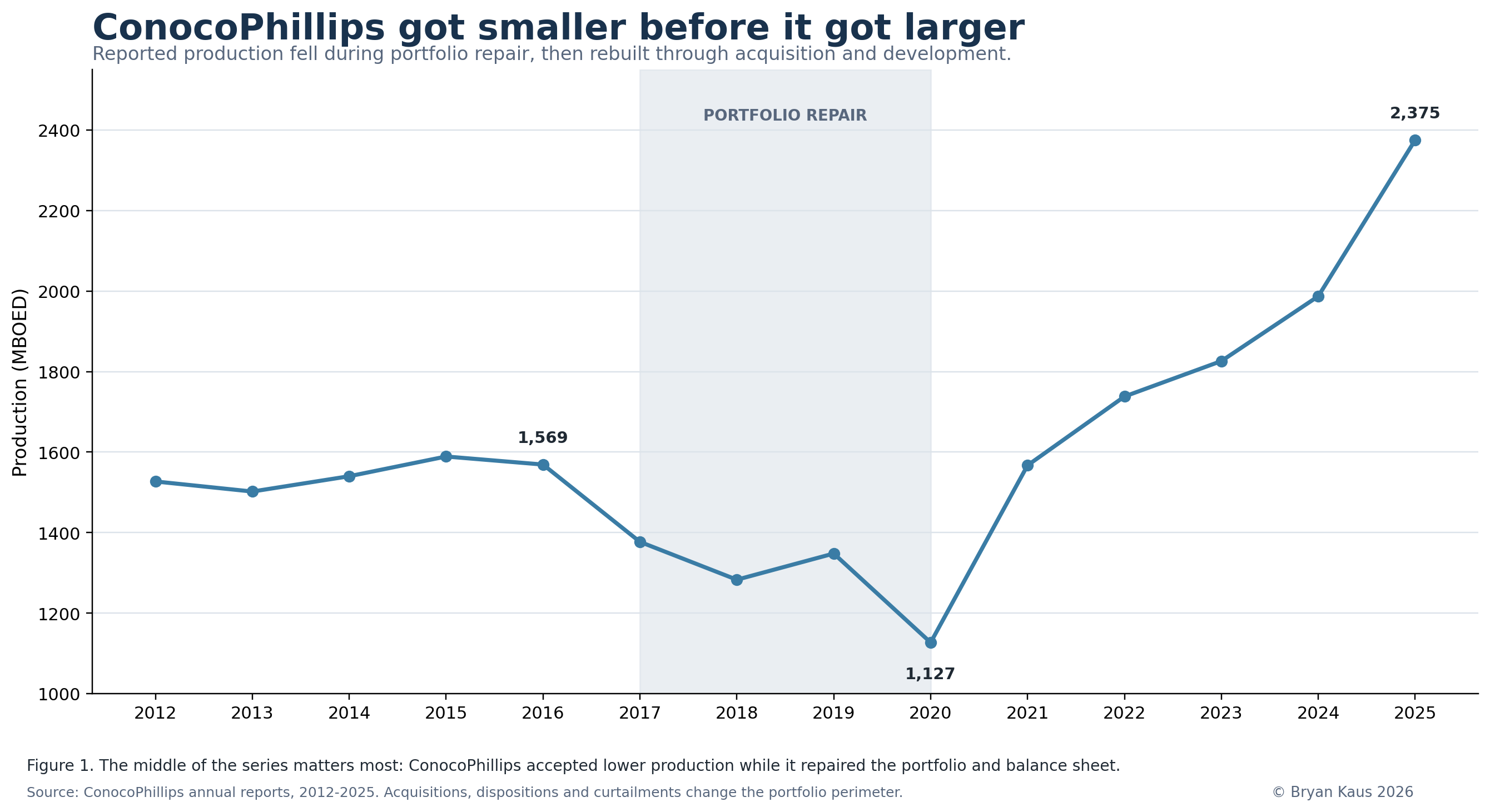
The middle of that production curve is more interesting than the endpoint. ConocoPhillips did not insist on preserving scale while repairing the company. Reported production fell from roughly 1.57 million BOE per day in 2016 to about 1.13 million in 2020 before rebuilding through Concho, Shell Permian, Surmont and eventually Marathon Oil.
I tend to think of cash and unused balance-sheet capacity differently than many corporate planning processes seem to. Cash is not automatically idle because it has not yet been assigned to something. If it lets you wait, reject an average deal, survive a bad market or move while someone else is negotiating with the clock, it is doing a job.
That is the deeper value of the Canada decision. ConocoPhillips became smaller in order to recover the right to be selective.
Liquidity is not merely defense. It is the ability to choose while somebody else is negotiating with the clock.
The next crisis was the proof
Then 2020 arrived.
Oil demand collapsed at a speed almost nobody had modeled. Producers cut capital, curtailed output and tried to preserve cash through one of the most violent dislocations the industry had experienced.
The important thing is not that ConocoPhillips avoided pain. It did not.
It is that the company confronting the second crisis behaved differently from the one that had confronted the first.
Lance's public language during that period is revealing. The emphasis was less on producing a heroic forecast than on protecting people and operations, preserving value, monitoring scenarios, curtailing production when the economics justified it, maintaining liquidity and keeping the ability to benefit when conditions recovered.
That sounds obvious after the fact. It is not. Leaders under pressure are rewarded for certainty even when certainty does not exist. One of the more useful things a leader can do in that moment is refuse to manufacture precision and instead build a system that can tolerate being wrong.
You do not have to know exactly what happens next if you have built an institution capable of surviving several versions of what happens next.
That is what strategic flexibility looks like when it stops being an investor-relations phrase and becomes operating behavior.
The right to play offense
In October 2020, while the sector was still recovering from the shock, ConocoPhillips announced the acquisition of Concho Resources for approximately $9.7 billion.
The financing matters as much as the headline price. The transaction was all-stock. Former Concho owners received about 15 percent of the combined company, which meant ConocoPhillips did not drain scarce cash or materially stretch the balance sheet at the bottom of the cycle.
Concho also brought more than acreage. It brought a large Permian inventory, operating knowledge and people who understood the system they had built. Concho founder Tim Leach joined the leadership team and board during the integration. ConocoPhillips ultimately reported savings well above the original target.
The commodity recovery helped enormously. That qualifier belongs in the story. Oil prices rescued plenty of 2020 decisions that would look less elegant under a weaker tape. Management should receive credit for the inventory, the financing, the integration and the timing - not for the fact that oil recovered.
What I find more distinctive is the sequence.
Repair first. Preserve liquidity. Use equity during dislocation. Use cash later, after cash generation recovers. Return to equity when the next large transaction changes the scale of the enterprise again.
That pattern carried from Concho into the $9.5 billion Shell Permian acquisition in 2021 and later into the Marathon Oil transaction. ConocoPhillips did not invent industry consolidation. ExxonMobil, Chevron, Occidental and others were moving toward deeper inventory and larger operating positions too. The stronger evidence of stewardship is that COP varied its funding form with the regime rather than treating one capital structure as permanently correct.
The right financing can be part of the strategy. The wrong financing can turn a good asset into a bad corporate decision.
Becoming ConocoPhillips
The other thing that happened after the reset is easy to miss if the story is told only as a sequence of transactions: ConocoPhillips developed an identity of its own.
It did not try to reconstruct the integrated company that had existed before the 2012 separation. It did not buy refining back. It did not turn itself into a pure Permian producer either.
Instead, the company assembled a portfolio with different clocks: a large short-cycle Lower 48 engine; long-duration positions in Alaska and Canada; selected international assets; and a growing LNG capability that can connect molecules, markets and commercial optionality across time.
There are trade-offs in that model. There always are. But it is recognizably ConocoPhillips.
That matters to me because strategy is not copying whatever portfolio architecture the market currently rewards. It is knowing what kind of company you are equipped to operate, where you actually have an ownership or capability advantage, and which attractive opportunities you should still decline.
The operating record moved with the portfolio. Reported production cost per BOE peaked at roughly $15.20 in 2014 and settled mostly into a $10 to $12 range through the later Lance years, while reported production eventually rose to about 2.38 million BOE per day in 2025.
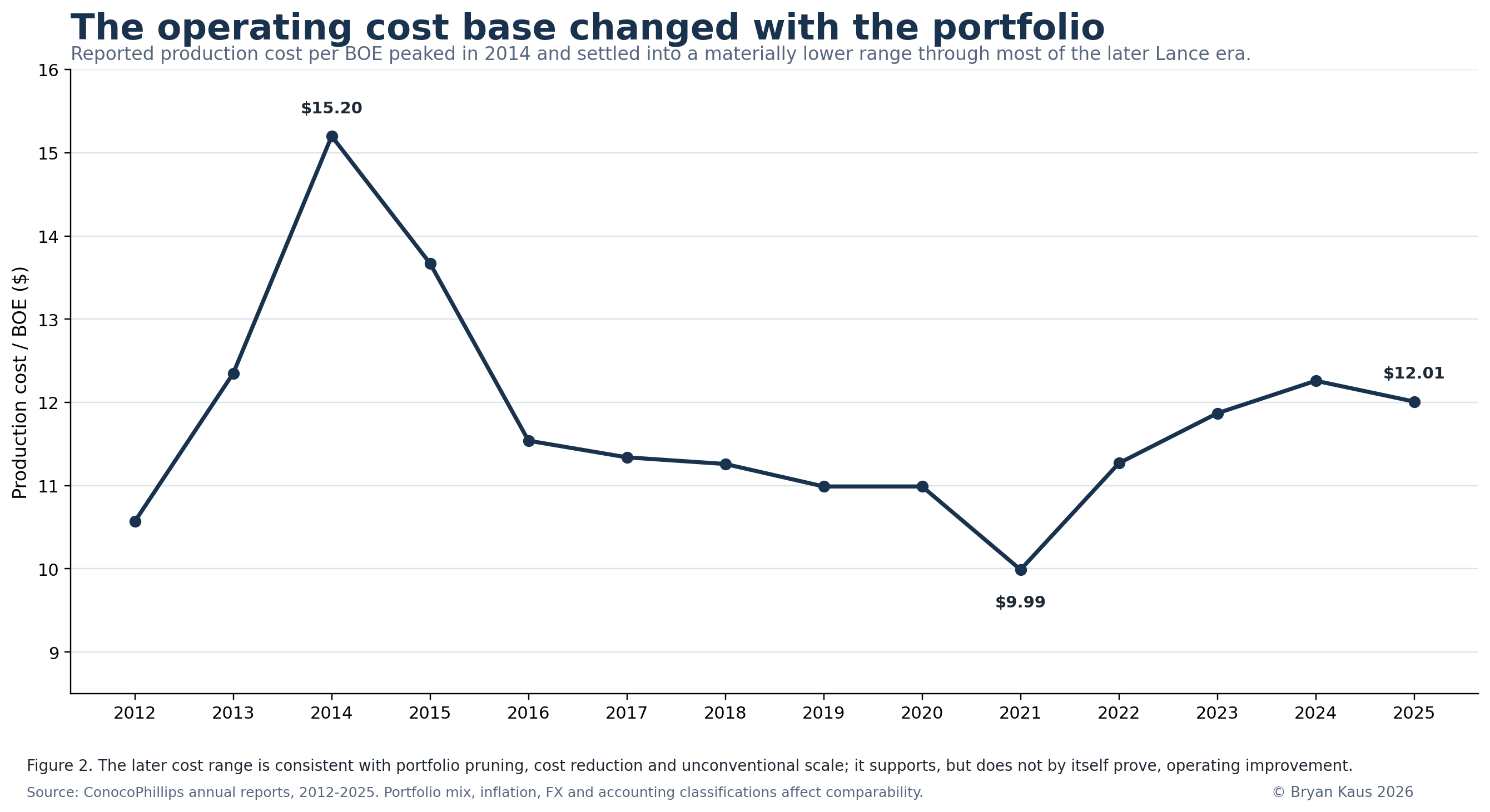
That is not a clean same-asset productivity comparison. Assets were sold. New assets were acquired. Currency, inflation, contractors and portfolio mix changed.
But that limitation is partly the point. Management was not simply trying to squeeze more from the inherited company. It was changing the assets, the capital intensity and the operating architecture underneath it.
The same caution applies to the workforce. ConocoPhillips reported roughly 19,100 employees in 2014 and about 9,900 in 2025 while production increased substantially. The rough production-per-employee ratio therefore improved dramatically.
That is directionally impressive. It is not proof by itself.
I am skeptical of any efficiency story that begins and ends with how many people disappeared from the denominator. Contractors can replace employees. Asset sales can remove labor-intensive businesses. An organization can become more productive, or it can simply run thinner until the true cost arrives in reliability, project execution, safety or lost institutional knowledge down the road.
Operational capability is an asset too.
What leadership looked like
After working through the filings and years of earnings calls, I do not come away particularly interested in deciding whether Ryan Lance was a visionary.
I was not inside his organization, and labels like charismatic, inspirational or beloved are difficult to establish from the outside and even harder to separate from mythology after fourteen years at the top. In conversations with friends, colleagues and associates, there was general respect - an engineer who understood the operations and translated that into the operating model. But those are the words of a few and opinions will always vary.
The printed record tells me something more useful.
Ryan Lance appears to have begun as an engineer-operator and matured into a capital allocator.
That distinction matters. The skills required to run an asset well are not exactly the same as the skills required to decide whether the company should continue to own it. One rewards mastery of the system you have. The other requires enough detachment to dismantle part of it.
His communication changed with the institution. Cost of supply. Returns on and of capital. Balance-sheet strength. Per-share growth. Flexibility. Through-cycle behavior. Cash flow. The repetition was useful because the decision system became legible.
The earnings calls also show Lance regularly handing detailed technical, commercial, transaction and financial questions to the executives responsible for them. That matters. A CEO's job is not to demonstrate that he can answer every question. It is to build an institution in which the right person owns the answer.
To me, that is the leadership story of the middle Lance era: an operating leader whose capital framework appears to have matured because the first framework had failed under stress.
The record still has scars
None of this requires turning the tenure into a blanket tribute piece.
ConocoPhillips' aggregate personal-safety performance improved substantially. Workforce total recordable rate fell from 0.28 in 2014 to 0.15 in 2025, and contractor performance improved as well.
Those results matter. They are not the entire record.
The company reported workforce fatalities in 2019, 2023 and 2024. Process-safety and spill results were not a perfectly straight line either.
Anyone who has spent time around industrial operations understands why those facts have to coexist. A favorable injury-rate trend tells us something important about the everyday operating system. A fatality tells us something else. One cannot mathematically cancel the other.
A fair judgment should be able to recognize genuine improvement without allowing the average to erase the severe event.
Success creates its own problem
By the end of the Lance era, ConocoPhillips had used the freedom created after 2016 to assemble a much larger opportunity set: Concho, Shell Permian, Surmont, Willow, Qatar, Port Arthur LNG, Marathon Oil and a broader international and commercial portfolio.
Most of those decisions can be defended individually.
That is exactly what makes the next problem difficult.
Good assets are not free because they are good. They consume capital. They consume people. They create interfaces, contracts, systems and claims on tomorrow.
By 2025, ConocoPhillips was again undertaking a significant competitiveness and workforce reset after several years of expansion. I see that as both a positive and a caution. Management recognized accumulated cost and complexity and acted. The caution is that the complexity accumulated in the first place.
There is an interesting symmetry here.
The danger at the beginning of the Lance era was too many fixed claims on capital.
The danger at the end may be too many individually attractive claims on capital and organizational attention.
Those are not the same problem. But they rhyme.
Ryan Lance leaves Andy O'Brien a better ConocoPhillips. He also leaves him a harder one to govern.
The strategy that restores a company's freedom can eventually create enough opportunity to spend that freedom away.
Source note Primary financial and operating data: ConocoPhillips Forms 10-K and annual reports, 2012-2025. Transactions: 2017 Cenovus/FCCL sale, Concho S-4/A, Shell Permian, Surmont and Marathon Oil disclosures. Leadership: ConocoPhillips proxy statements and official earnings-call transcripts sampled from 2017-2026. Safety: ConocoPhillips sustainability performance tables and 2026 proxy materials. Interpretive framework and derived calculations: Kaus Capital / Australis full-cycle Ryan Lance tenure study, based on public information.
Disclosure. This essay is an independent operator-investor assessment based on public information. Bryan J. Kaus worked for ConocoPhillips before the 2012 separation and chose the Phillips 66 side; he did not work inside the Ryan Lance-era upstream company. Nothing here constitutes investment advice or a recommendation to buy or sell any security.
© 2026 Bryan J. Kaus
What This Means for a Decision
If this analysis bears on a decision in front of you, this is the work the firm does on it.
Related workValue Acceleration Blueprint →