Energy & Infrastructure
LatestConocoPhillips: From Reset to the Next Test · Part III of III
The Next Test at ConocoPhillips
Essay · · 15 min read · By Bryan J. Kaus
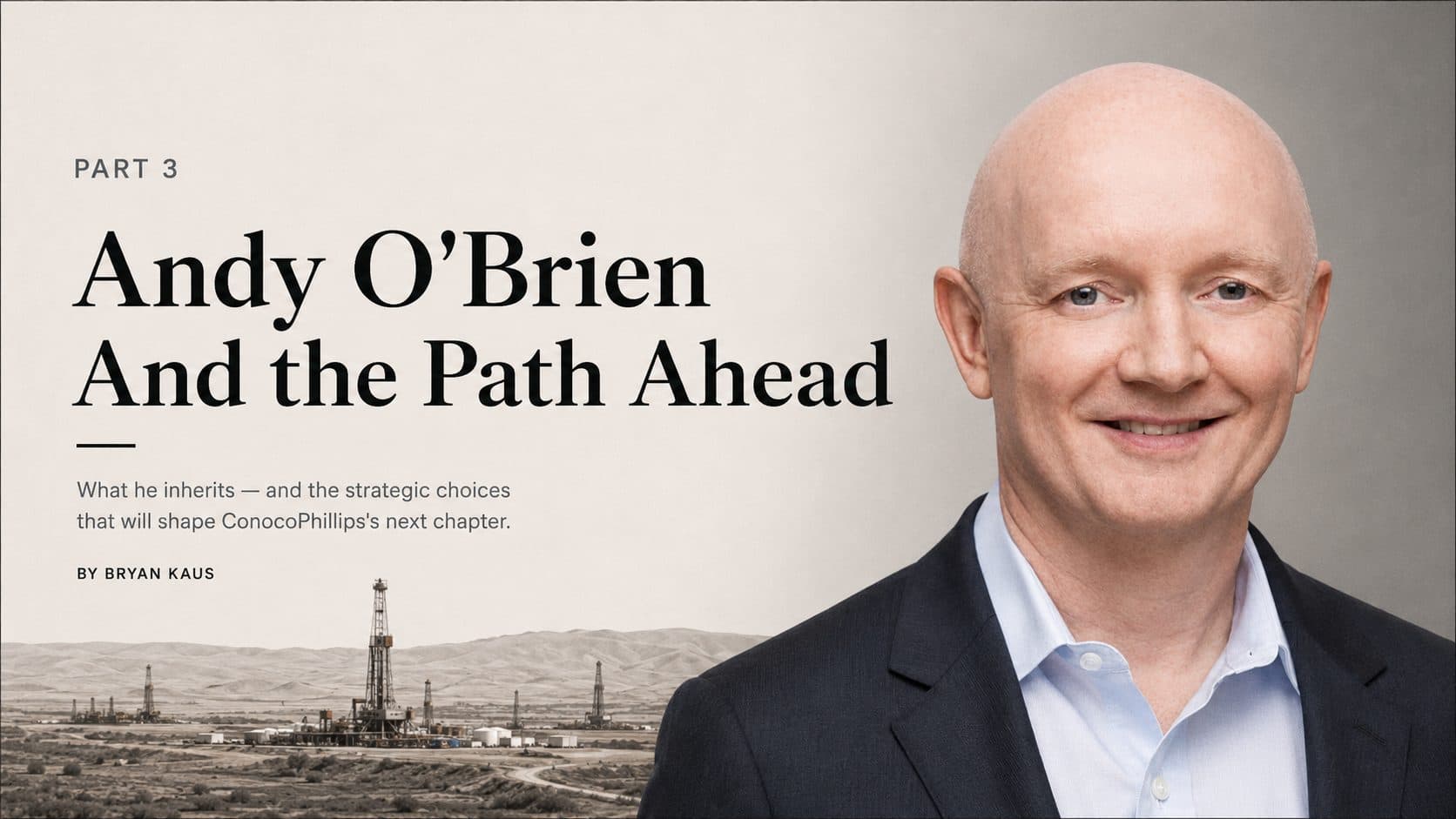
The assets are largely there. The strategy is largely there. The test is whether a larger, more complex ConocoPhillips can still move with discipline when the market turns.
Andy O'Brien is not inheriting a turnaround. He is inheriting a conversion test.
Ryan Lance leaves him a better ConocoPhillips. He also leaves him a company that is more difficult to govern.
The answer up front is that O'Brien does not need to invent a new ConocoPhillips to prove he is in charge. He needs to make the enlarged company behave like one engine, one economic system without spending away the strategic freedom Lance restored after 2016. That means proving four things: transaction ancestry carries no economic privilege in future capital allocation; complexity earns its keep; cost reduction does not quietly liquidate operating capability; and LNG and new geographies add optionality without being allowed to codify into another rigid stack of fixed claims.
The market should judge that work across three balance sheets - financial capacity, operating capability and strategic freedom - and in a deliberate sequence: Protect -> Convert -> Prune -> Prove. If ConocoPhillips can do that while lifting mid-cycle free cash flow per share, preserving safety and technical depth, and keeping enough liquidity to act countercyclically, the late-Lance scale will have become durable owner value. If it cannot, this portfolio of individually good assets can still become collectively rigid and create value and operational drag.
That is pretty much the argument. The reason understanding this matters is that successful transformation often produces exactly this problem: a company solves one constraint, builds new capabilities, creates new options - and eventually discovers that the accumulated options have become a new management challenge/complexity of their own.
After finishing the Lance-era work, I did the next exercise I would want done if I were in the cockpit and owned the whole company (*Disclaimer: I hold a small equity position in COP)*: forget the transaction labels for a moment and treat every asset, contract, partner relationship and capital claim as though ConocoPhillips were deciding - right here and now - whether to own it or not.
I didn't come away thinking ConocoPhillips has an asset quality problem. Actually, quite the opposite. The portfolio contains a lot of things many companies would be happy to own. What it has is the risk of a portfolio-governance problem. Bad assets are relatively easy to identify. A collection of individually good assets can be harder because each arrives with a reasonable argument for another dollar of capital, another specialist team, another contract, another country or another exception. Eventually a company can lose flexibility without ever making one obviously foolish decision. Actually, this is where you can do all of the theoretically correct things, without accounting for the sum of the parts and the complexity that creates.
The risk success creates
This is where the Lance story circles back on itself.
The lesson of the early chapter of ConocoPhillips under Lance was not simply that oil prices can fall. Everyone in the business already knew that. The deeper lesson was that fixed claims on capital can quietly outrun a company's degrees of freedom. Major projects, production growth, a premium dividend and balance-sheet strength were each defensible. The problem was treating too many of them as fixed when the sources of cash funding them was significantly variable.
The numbers are useful because they strip away hindsight. Across 2012-2016, ConocoPhillips reported about $58.6 billion of net cash provided by operating activities while spending about $61.7 billion on capital expenditures and investments, before dividends. The first serious downturn did not invent the tension. It revealed an architecture with too little room for disappointment.
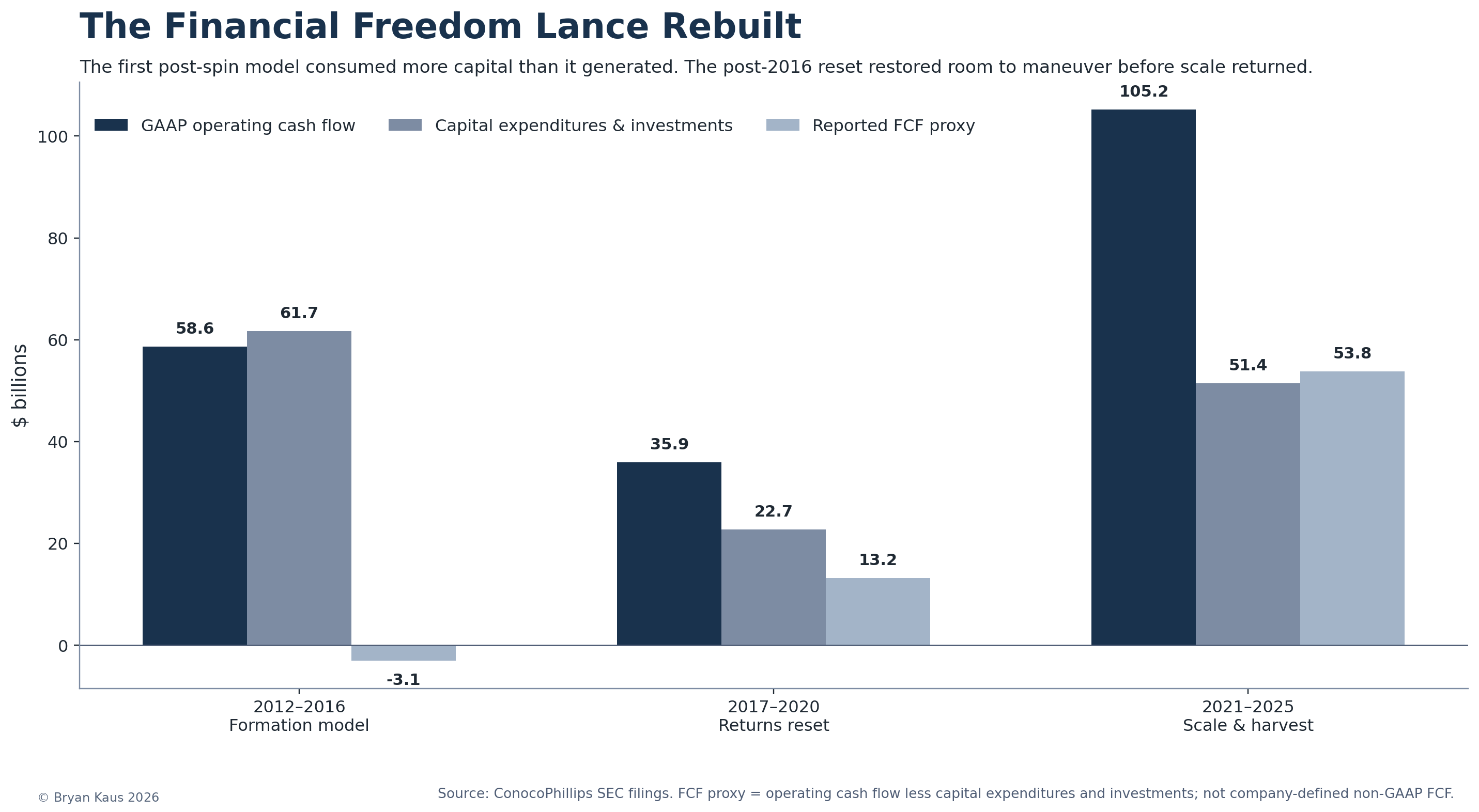
Figure 1. Strategic-era cash generation and capital intensity. Source: ConocoPhillips SEC filings. FCF proxy equals reported net cash provided by operating activities less capital expenditures and investments; it is not ConocoPhillips' company-defined non-GAAP FCF.
The post-2016 reset changed that. Capital intensity fell, the balance sheet was repaired, the portfolio was pruned, and strategic freedom became something the company could use rather than merely promise. That freedom mattered when ConocoPhillips could curtail through the 2020 shock, acquire Concho with equity, buy Shell Permian with cash after conditions recovered, and later add Marathon Oil from a position of strength.
Strategic freedom compounds. But once management creates it, it can spend it away.
In 2026, the company is materially stronger. On the August 6 earnings call, which I read rather than listening to, management described a company producing above guidance, generating $4.2 billion of free cash flow in the quarter, returning $3.0 billion to shareholders and still targeting a $7 billion free-cash-flow inflection by 2029. O'Brien also made an important continuity statement: cost of supply, capital allocation, returns on and of capital, disciplined execution and ongoing portfolio high-grading are not changing.
That matters because the fair critique is not that ConocoPhillips has forgotten portfolio discipline. Publicly, it says the opposite - and there is evidence behind that claim. The harder question is how the market will know that the discipline has penetrated beneath the transaction level and into the operating system.
A good strategy does not fail only because somebody makes one spectacularly bad bet. It can fail through the accumulation of reasonable ones that add complexity and dependency etc.. The next ConocoPhillips therefore has to rank not only projects against projects, but commitments against the value/flexibility/freedom of remaining uncommitted.
A new CEO does not always need a new strategy
There is a human problem inside every succession that rarely appears in the investor deck.
A new chief executive is expected to show authorship. Employees want to know what changes. Investors ask for priorities. Boards want evidence of momentum. The temptation is to announce a new framework simply because the captain of the ship has changed. Fourteen years under one CEO creates institutional habits and expectations, as well as strategy. A successor inherits both.
I don't think that is Andy O'Brien's problem. What he inherits is a conversion problem, not a strategy vacuum.
ConocoPhillips already has a recognizable model: cost-of-supply discipline, a large short-cycle Lower 48 engine, long-duration Alaska and Canada, LNG and selected international options, all supported by a balance sheet designed to survive the cycle. On his first earnings call after being named successor, O'Brien was explicit that the strategic pillars remain intact - but - importantly - equally explicit that continuity should not be confused with complacency.
O'Brien's background is relevant because it spans more than finance. His career crossed investor relations, Lower 48 finance, corporate planning and development, treasury, global operations, strategy, commercial, LNG, M&A and finally the CFO role. That breadth helps explain the board's choice. It does not answer the larger questions. He has not yet demonstrated how he will lead the company through a severe downturn, challenge a major legacy commitment, balance financial discipline against operating capability, or establish his own authority across an organization built during Lance's fourteen years as CEO. Those tests begin now.
The governance question needs to be addressed directly. Lance will remain transitional executive chairman, but he explicitly said O'Brien will have full accountability for leading the company and managing day-to-day operations. The future test is whether O'Brien visibly uses that authority when an inherited assumption - even a successful one - deserves/requires changing.
The three balance sheets
The most useful way I have found to think about the next phase is that O'Brien inherits three balance sheets, not one.
1. The Financial: cash, debt, fixed commitments, working capital, collateral and the ordinary claims that determine whether the company can survive a bad market without somebody else dictating the timetable. 2. Operating-Capability: people, technical depth, maintenance systems, safety culture, contractor capability, partner relationships and organizational bandwidth. Those assets rarely appear at fair value in the financial statements, but they determine whether the company can actually exploit the portfolio it owns. 3. Strategic-freedom: uncommitted capital, unsanctioned inventory, discretionary Lower 48 spending, commercial options, geographic options and the ability to move when the rest of the industry is constrained.
A decision can improve one of those balance sheets while quietly drawing down another. That is where the second-, third- and fourth-order effects live.
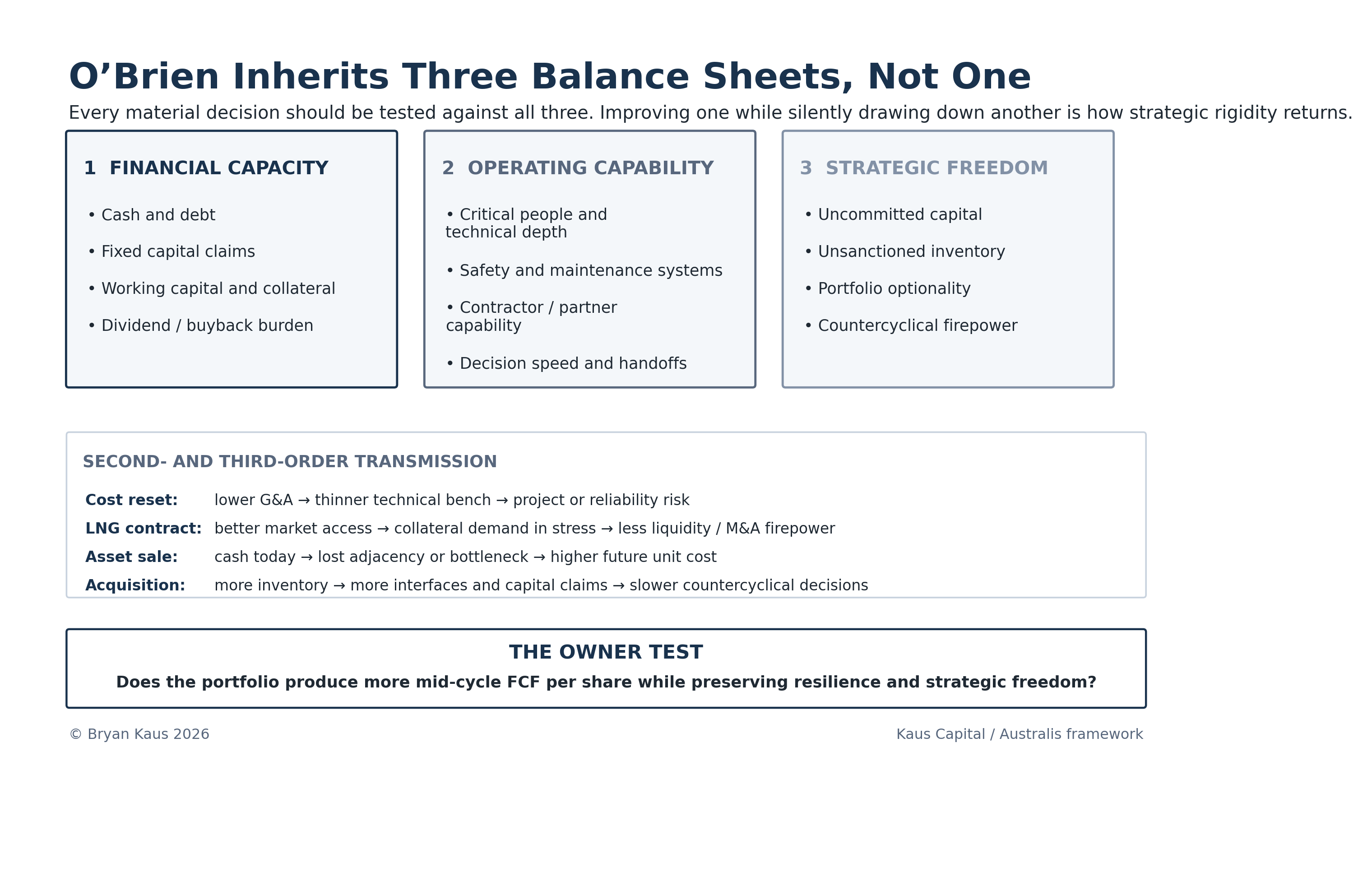
Figure 2. The three-balance-sheet test. Every material decision should be evaluated against financial capacity, operating capability and strategic freedom - not one dimension in isolation. Framework: Kaus Capital / Australis.
A workforce reduction can improve the financial balance sheet. If it removes technical depth, however, projects can slip or reliability can deteriorate and there is a real cost to that. If that happens, the optionality embedded in the portfolio is worth less because the institution has less capacity to exploit it.
A long-term LNG agreement can improve market access and create optimization value. It can also create basis, destination, counterparty and collateral exposures. In a severe dislocation, those exposures can consume liquidity precisely when distressed physical assets become available. A commercially attractive contract can therefore affect future M&A firepower several steps later.
An asset sale creates cash immediately. But if the asset carried a bottleneck, adjacency or infrastructure right that improved the economics of surrounding assets, the next-order effect may be worse realizations or higher future capital requirements. 'Non-core proceeds' are not automatically owner value.
An acquisition adds inventory. It also adds complexity through... interfaces, systems, facilities, partner relationships and capital claims. If those slow decisions, the fourth-order cost of scale can be lost countercyclical speed.
From transaction integration to owner optimization
The most immediate example is the Lower 48.
ConocoPhillips can reasonably say that the Marathon Oil asset integration is complete. It has reported substantial run-rate synergies, completed its formal disposition target and continues to say that assets compete for capital on cost of supply. I take their work on that. But integration and full owner optimization are not the same thing.
Integration asks whether the acquired organization and assets have been combined successfully. Owner optimization asks the harder, ongoing question: if ConocoPhillips were assembling the portfolio from scratch today, would capital, infrastructure, acreage and organizational attention be allocated exactly as they are now? Or... would we change it?
There should ultimately be one forward development queue using the same price decks, the same full-cycle cost definitions and the same burden for facilities, water, gathering and processing, transport, royalties, taxes and sustaining overhead. Acreage geometry *should* matter. Longer laterals *should* matter. Duplicate facilities/capacities *should* matter. Commercial realization *should* matter. Base decline and maintenance capital *should* matter. The best development block *should* win because it has the best forward economics - not because of which transaction brought it into the company.
The proof should eventually show up in capital migration: development sequencing, possibly acreage swaps and block consolidation, infrastructure rationalization and unit economics. Transaction lineage may remain useful for accounting and integration history; BUT it should carry absolutely no economic privilege/benefit of the doubt in forward capital allocation.
That is the step beyond integration. Not another synergy program. It's capital governance - continually re-underwriting the combined and evolving system as though every dollar and every asset had to earn its place again today.
Make complexity pay rent
The same principle extends beyond the Lower 48.
I would not use a simplistic core-versus-noncore litmus. Core is not a synonym for large, profitable, historic or politically important. The better question is whether ConocoPhillips is the advantaged owner after accounting for capital intensity, control, infrastructure, partner structure, political risk, corporate support and management attention.
Some ownership cases are pretty intuitive. Scale and operating learning in the Delaware basin matters. Alaska infrastructure matters because it protects market access and development economics. The Ekofisk-Norpipe-Teesside system has value specifically because production, transportation and processing reinforce one another. Surmont provides long-duration, low-decline cash flow. APLNG and Qatar pair resources with LNG capabilities the company has spent decades building.
Other positions deserve greater scrutiny. A good non-operated interest in a distant geography can still consume disproportionate governance and management attention. A subscale platform can sit in a portfolio for years because it is too good to abandon and too small to prioritize. A commercial LNG contract can create real optimization value while also adding things like collateral, basis and counterparty risk that is difficult to see in a conventional asset map.
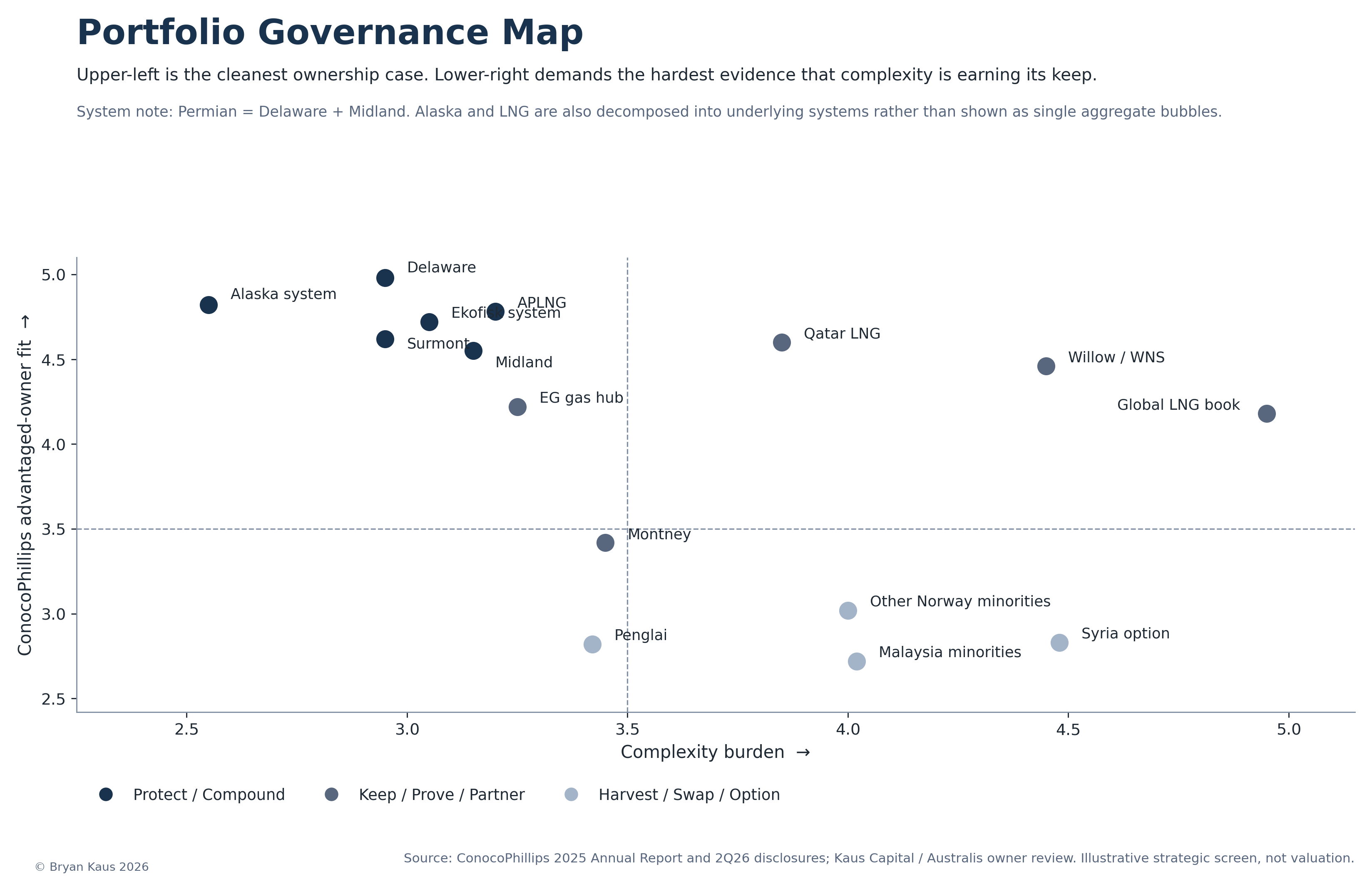
Figure 3. Illustrative portfolio-governance screen. The question is not whether an asset is good, but whether ConocoPhillips is the advantaged owner after complexity is counted. This is a strategic heuristic, not a valuation.
This is why I would make complexity pay rent.
And to be clear - I would stress not doing this with false precision - *there's often a temptation to seek that*. Management attention can't be reduced to a perfect spreadsheet number. But a conventional project IRR that charges capital while treating organizational burden as free is... incomplete. The ask should be what support, logistics, political risk, legacy obligations and management interfaces an asset requires - and whether ConocoPhillips creates enough incremental value by owning it to justify that burden.
Commercial capability has to become visible as value
The LNG portfolio deserves a closerlook because it may represent one of the most interesting capabilities the modern ConocoPhillips has built.
The company now combines equity LNG in Australia, Qatar and Equatorial Guinea with Port Arthur LNG equity and offtake, Gulf Coast and Asian offtake, regasification and marketing positions, and its Optimized Cascade liquefaction technology. On the recent earnings call, O'Brien explicitly described the strategy as unchanged and illustrated the cash-flow sensitivity: a $1/MMBtu margin on 5 MTPA would equate to roughly $200 million of cash flow. That was a sensitivity illustration rather than a forecast.
And that may be right. But MTPA is a scale statistic, not a value statistic.
The real market test should be the incremental cash margin ConocoPhillips creates versus selling the molecule at the nearest liquid market - net of transport, capacity costs, collateral, basis exposure and cash-at-risk. If the commercial system consistently improves realizations and diversification without compromising liquidity in stressed market conditions. If the value is mostly gross volume and favorable spot conditions, it is less exciting than it looks.
This matters in a market that is still expanding. Took me a bit to find the numbers but the EIA's August 2026 Short-Term Energy Outlook forecasts U.S. LNG gross exports averaging about 17.4 Bcf/d in 2026 and 18.6 Bcf/d in 2027. More export capacity creates opportunity, but also a more competitive and contract-intensive optimization environment.
Protect capability while simplifying
This is also where the people question becomes unavoidable.
ConocoPhillips has been through a significant cost and workforce reset(s). You cannot count a workforce reduction as productivity on announcement day. A smaller headcount proves very little by itself.
The justification/success is proven when you see lower G&A and lower unit cost while safety, uptime, maintenance integrity, project delivery and critical technical depth hold or improve. If contractor spending replaces employees, projects slip, incidents rise or deferred work begins appearing later, some of the savings were simply moved from one line of the organization to another.
A simpler organization should require fewer handoffs, not merely fewer people.
If headcount falls but the same committee structure, systems, approvals, interfaces and work remain, complexity has not disappeared. It has been transferred onto fewer people. Eventually that shows up in decision latency, turnover, contractor cost, rework, reliability or project execution. *[This is exactly where/why many "transformations" fail]*
Operational capability is an asset too. That matters especially in Alaska, LNG and complex international operations, where institutional knowledge is expensive to recreate once it leaves. The objective should be a leaner organization, not a thinner one that erodes future reliability, flexibility and strength.
New geographies: cheap options can still create expensive organizations
The recent Iraq and Syria moves deserve a more nuanced reading than a simple warning about another capital call.
Management's first-order case is stronger than that. For Kirkuk, O'Brien said expected acquisition capital at close is roughly $300 million to $500 million, with the joint venture then expected to fund its own activity largely from asset cash flow. He called the Iraq and Syria opportunities as existing or previously producing resources with low entry costs rather than a new greenfield mega-project program.
That makes the capital logic potentially attractive. Kirkuk in particular looks much more like a capital-light redevelopment option than a new mega-project commitment.
The second-order question is different. Several inexpensive options can gradually create a regional organization, security apparatus, partner network and management commitment that becomes expensive to unwind. As noted earlier, this is how complexity often enters a company: one rational exception at a time.
The right answer is not to avoid those opportunities, but to manage them as a portfolio of geopolitical optionality. The important question isn't merely whether each field meets cost of supply. The question is whether the collection strengthens the system ConocoPhillips is trying to become. *Does it fit? Why?*
Protect -> Convert -> Prune -> Prove
If I reduce the next several years to a sequencing scenario, that is the order I would use.
Protect first: safety, maintenance integrity, critical capability and enough balance-sheet capacity that management is never forced to make a strategic decision on somebody else's timetable. Then protect an ordinary dividend deliberately sized to remain durable through the cycle - *this is the lesson learned from Ryan Lance's first era*. Variable repurchases should remain exactly that - variable and opportunistic.
That distinction is important because the company is currently targeting approximately 45% of CFO returned to shareholders in 2026 and continues to emphasize peer-leading distributions. That can be a reasonable framework but it should not become an unassailable guarantee.
Then convert: one asset register, one Lower 48 capital ranking, a visible commercial-realization bridge and a clear view of the cash at risk inside the LNG and contract portfolio. Marathon synergy should show up in unit economics, free cash flow, safety and operating performance - not only in an expense-reduction number.
Then prune: make binary decisions on middle-child assets, swap or harvest fragments where another owner has a structural advantage, and resist fixed disposition targets that turn portfolio management into a quota. Selling is not inherently disciplined. Neither is keeping.
Finally prove: show that the enlarged company can produce resilient mid-cycle free cash flow per share while Willow, LNG and the Lower 48 deliver safely and the organization retains the capability required to operate them.
The sequence matters because a company can simplify too aggressively and destroy capability, or grow too quickly and consume the optionality it intended to preserve. The job is not subtraction for its own sake. It is conversion of accounting ownership into economic ownership.
What O'Brien ultimately has to prove
The test is pretty straightforward: protect the financial and operating foundations; convert the acquisitions into one economic system; prune complexity where ConocoPhillips is not the advantaged owner; and prove the result through mid-cycle free cash flow per share, safety, reliability and retained countercyclical firepower.
The most important O'Brien decision may ultimately be cultural rather than transactional: does ConocoPhillips continue to treat strategic flexibility as an asset that must earn a return, or does unused capacity begin to look like cash waiting to be spent?
The second interpretation is tempting, especially in a favorable market. Strong cash generation makes every project look more affordable. A deep inventory makes another acquisition seem easier to absorb. New geographies often begin as inexpensive options. Shareholder-return targets begin to feel permanent.
That is how rigidity returns - one reasonable decision at a time.
Ryan Lance's middle-tenure achievement was restoring the company's ability to choose. The task facing O'Brien is to prove that the enlarged ConocoPhillips can keep that ability while converting the opportunities Lance accumulated into durable owner economics.
He does not need to prove that every inherited decision was right.
He needs to preserve an institution capable of discovering when one is not and acting accordingly.
The owner's test is simple to say and difficult to practice:
Stop asking only: "Is this a good opportunity?" Ask: "Is this better than every opportunity - and every degree of strategic freedom - we already own?"
That is the next test at ConocoPhillips. I wish Andy and the ConocoPhillips team success on the road ahead.
Research basis: ConocoPhillips SEC filings and annual reports; 2026 proxy statement; Q2 2025 and Q2 2026 earnings materials; August 6, 2026 earnings-call transcript and succession announcement; and the U.S. Energy Information Administration's August 11, 2026 Short-Term Energy Outlook. Research and fact-check current through August 13, 2026. Forward-looking items such as the 2029 free-cash-flow inflection are management targets, not realized results. Asset-level recommendations remain strategic hypotheses, not transaction instructions.
What This Means for a Decision
If this analysis bears on a decision in front of you, this is the work the firm does on it.
Related workValue Acceleration Blueprint →